
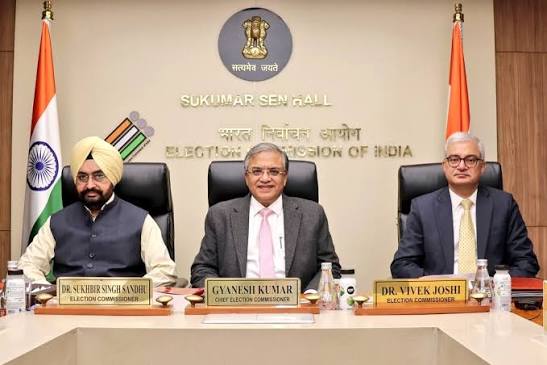
A fresh controversy has erupted around the Election Commission of India (ECI) after an investigation by The Indian Express reported that Election Commissioners Sukhbir Singh Sandhu and Vivek Joshi formally recorded objections at least 14 times over a 10-month period to decisions and orders concerning electoral-roll management.
The reported objections came during the nationwide expansion of the Special Intensive Revision (SIR) of electoral rolls, an exercise that has so far resulted in more than 13 crore names being removed from draft electoral rolls across 30 States and Union Territories. The scale of the revision and the reported internal disagreements have triggered a new political confrontation over how India's voter lists are being prepared and managed.
At the same time, the Election Commission has rejected the suggestion that the reported objections represent a breakdown or division within the Commission. According to ECI sources, all final decisions, including those concerning SIR, were taken unanimously by all three Election Commissioners.
The controversy therefore revolves around two competing accounts: the Indian Express investigation's account of repeated formal objections by two commissioners, and the ECI's position that these differences were part of normal internal deliberation and did not alter the unanimous decisions of the full Commission.
What is the Special Intensive Revision?
The Special Intensive Revision, or SIR, is an exercise undertaken by the Election Commission to comprehensively review electoral rolls. The process began in Bihar in June 2025 and subsequently expanded to other parts of the country. The stated objective is to ensure that electoral rolls contain eligible voters while identifying names that may need to be removed because of reasons such as death, migration, or other eligibility-related issues.
According to data reported by The Indian Express, the exercise has resulted in more than 13 crore names being left out of draft electoral rolls across 30 States and Union Territories.
An important distinction is necessary here:
The reported figure refers to names removed from draft rolls, not necessarily to 13 crore people permanently losing their right to vote.
Electoral-roll revision processes include mechanisms through which eligible people can raise objections, submit documents and seek inclusion or restoration of their names. That distinction is important when interpreting the numbers.
The 14 Objections That Triggered the Controversy
The Indian Express investigation says Sandhu and Joshi placed objections on record at least 14 times during 10 months. Four of those objections were reportedly made on a single day. The objections were not limited to one technical issue. They reportedly covered several areas at the heart of electoral-roll management:
This is significant because electoral rolls form the foundation of the voting process. Before an election can take place, authorities must determine who is registered to vote in each constituency.
Why Form 6 Became an Important Flashpoint
One of the major disputes concerned Form 6, the statutory form used by citizens applying for inclusion in the electoral roll.
According to the Indian Express investigation, a new declaration was introduced on the Commission's online system asking applicants whether their name, or the name of a parent or grandparent, appeared in the electoral roll from the previous SIR. The report said applicants could not proceed with the application without answering the question. This reportedly concerned Sandhu and Joshi because they had earlier taken the position that the statutory Form 6 could not simply be altered through an administrative or software change.
The reported internal records indicate that Joshi argued in May that Form 6 was prescribed under the Registration of Electors Rules, 1960, and therefore could not be altered without the necessary legal process. Sandhu subsequently also objected to the change. The Indian Express reported that Sandhu described the change as "unauthorised and illegal" and called for its removal. The dispute, therefore, was not simply about the wording of an online form. It raised a broader question:
Who has the authority to change the process through which a citizen applies to become a voter?
Another Major Issue: Who Controls the Voter Database?
The second major area of concern involved the technology used to manage electoral rolls. For years, electoral-roll management has relied on systems such as ERONet. The Commission subsequently introduced ECINet, a broader digital platform intended to integrate multiple election-related applications and services. The Indian Express investigation reported that Sandhu and Joshi repeatedly raised concerns about what they described as the centralisation of electoral-roll database access in Delhi. Their concern, according to the investigation, was that Electoral Registration Officers (EROs) at the constituency level could potentially have their ability to perform statutory functions restricted by the central IT system. This is an important issue because India's electoral-roll system traditionally involves officials operating at different administrative levels. If an ERO has the statutory responsibility for maintaining a constituency's electoral roll, questions arise over what happens if the software used by that officer does not allow an action that the officer is otherwise legally authorised to take.
Why ERONet and ECINet Matter
In simple terms, electoral-roll software is the digital infrastructure behind voter lists.
It can be used for functions such as:
- Adding a new voter
- Updating voter information
- Deleting names
- Restoring names
- Processing applications
- Recording decisions of election officials
- Maintaining electoral-roll databases
The Indian Express reported that concerns were raised internally about whether technological controls were beginning to override or restrict the authority of officials responsible for electoral rolls at the ground level.
That creates an important governance question:
Should software merely implement the decision of a legally authorised election officer, or can the software itself determine what that officer is able to do?
That question has become one of the central themes of the current controversy.
The Goa Example
The investigation also highlighted a case from Goa involving 97 voters.
According to the Indian Express, these voters were reportedly found eligible by the relevant Electoral Registration Officer after they produced the required documents. However, the software allegedly did not allow the officer's decision to be properly reflected in the final electoral roll.
The case illustrates why the disagreement over software access is important.
If a local statutory officer determines that a person is eligible, but a centralised technological system prevents that determination from being entered or implemented, the question becomes one of institutional responsibility and accountability. The Commission's response to such specific cases remains an important part of understanding the controversy.
Concerns Over Voter Deletions and Appeals
The objections reportedly also involved the process for deleting and restoring voter names. The investigation said the two commissioners raised concerns about:
- Deletion of voters
- Restoration of names
- Appeals against decisions restoring voters
- The manner in which these processes were handled through the Commission's systems
These issues are particularly significant during SIR because the revision involves large numbers of voters simultaneously. Even if the overall purpose is to remove ineligible entries, the process must also provide eligible citizens with a meaningful opportunity to challenge an incorrect deletion. This is why the controversy is not simply about the number of names removed. It is also about how decisions were made, who made them, what safeguards existed, and how citizens could appeal.
The Cabinet Secretary Was Also Approached
One of the most notable developments reported by The Indian Express concerns the escalation of the dispute beyond the Election Commission.
The newspaper reported that Sandhu and Joshi separately wrote to Cabinet Secretary T. V. Somanathan over concerns involving changes in the allocation of administrative and IT-related responsibilities.
According to the report, they believed the changes could further centralise control over the technological infrastructure supporting electoral rolls. This is significant because the Election Commission is a constitutional authority and normally operates independently of routine executive control. The fact that the two commissioners reportedly raised concerns with the country's top civil servant therefore adds another dimension to the controversy.
What Does the Election Commission Say?
The Election Commission has rejected the interpretation that these objections demonstrate a split in the Commission's final decision-making. According to ECI sources, all decisions of the Commission, including those related to SIR, were taken unanimously by the three Election Commissioners. The Commission's position is that individual observations, objections and technical suggestions can occur during internal deliberations. What matters, according to its response, is the final decision formally taken by the Commission.This creates an important distinction:
Internal disagreement
An Election Commissioner can raise questions, suggest changes or record an objection during deliberations.
Final Commission decision
The Commission can nevertheless arrive at a final decision that all three members approve. The ECI says that is what happened with SIR and its other decisions.
Why Opposition Parties Are Angry
The report has triggered a strong political response from opposition parties that have already been questioning the SIR exercise. Opposition leaders have argued that the reported internal objections strengthen their existing concerns about the electoral-roll revision process.
Rahul Gandhi renewed his criticism of the Election Commission and repeated his allegation of "vote chori" in response to the report.
Arvind Kejriwal also attacked the Commission following the report and called for action against CEC Gyanesh Kumar.
Other opposition parties and leaders have demanded action ranging from an investigation to proceedings concerning the removal of the Chief Election Commissioner. These are political allegations and demands, rather than established findings that electoral fraud occurred.
The Removal Demand Against Gyanesh Kumar
The controversy has also intensified existing opposition demands concerning Chief Election Commissioner Gyanesh Kumar. Opposition parties have cited the reported objections by Sandhu and Joshi as grounds for questioning the functioning of the Commission and demanding Kumar's removal or parliamentary proceedings against him. However, the reported objections themselves do not automatically establish that the CEC acted unlawfully. Determining whether any particular action violated election law would require examination of:
- The relevant statutory provisions
- The Election Commission's official orders
- The written objections
- The final decisions of the Commission
- The authority under which each decision was made
- The applicable rules governing electoral-roll revision
Those questions remain central to the continuing dispute.
The Bigger Question: Who Makes the Final Decision?
At the heart of the controversy is a basic institutional question:
When the Election Commission acts, does the decision represent the considered decision of the full three-member Commission?. The Indian Express investigation says the two commissioners repeatedly objected to actions they believed had been taken without their knowledge. The Election Commission, meanwhile, says its final decisions were unanimous. Both claims can be understood only by examining the underlying official records. The key issue is therefore not simply whether disagreements existed.
The bigger question is:
What happened between the initial objections and the final orders?
Why the 13-Crore Figure Needs Context
The figure of more than 13 crore names removed from draft electoral rolls has become one of the most widely discussed aspects of SIR.
But the number requires careful interpretation.
A name appearing in the pre-revision roll and not appearing in a draft roll does not necessarily mean that the individual has permanently lost voting rights.
Draft rolls are part of a process that allows claims and objections.
For example, The Indian Express previously reported that the Delhi electoral roll fell from about 1.45 crore electors before SIR to 97.53 lakh in the draft roll, while Maharashtra's figure fell from about 9.78 crore to 7.71 crore.
Therefore, the ultimate impact of SIR needs to be assessed using the final electoral rolls, not only the initial draft deletions.
What Happens Next?
Several questions are likely to remain at the centre of the debate:
1. Will the Election Commission publish the relevant records?
The written objections of the two commissioners are now central to the controversy. Greater transparency about the objections and the Commission's responses could help establish what happened.
2. Will the disputed Form 6 changes remain?
The controversy over the additional declaration has raised questions about the legal procedure used to modify the voter-registration process.
3. Will the Commission clarify control over ECINet?
A major issue is whether constituency-level Electoral Registration Officers retain effective statutory control over their functions.
4. What happened to the deleted voters?
The final rolls will be important in determining how many people were ultimately restored and how many remained excluded.
5. Will Parliament or the courts examine the allegations?
Opposition parties have called for further action, while the Election Commission maintains that its decisions were unanimous.