
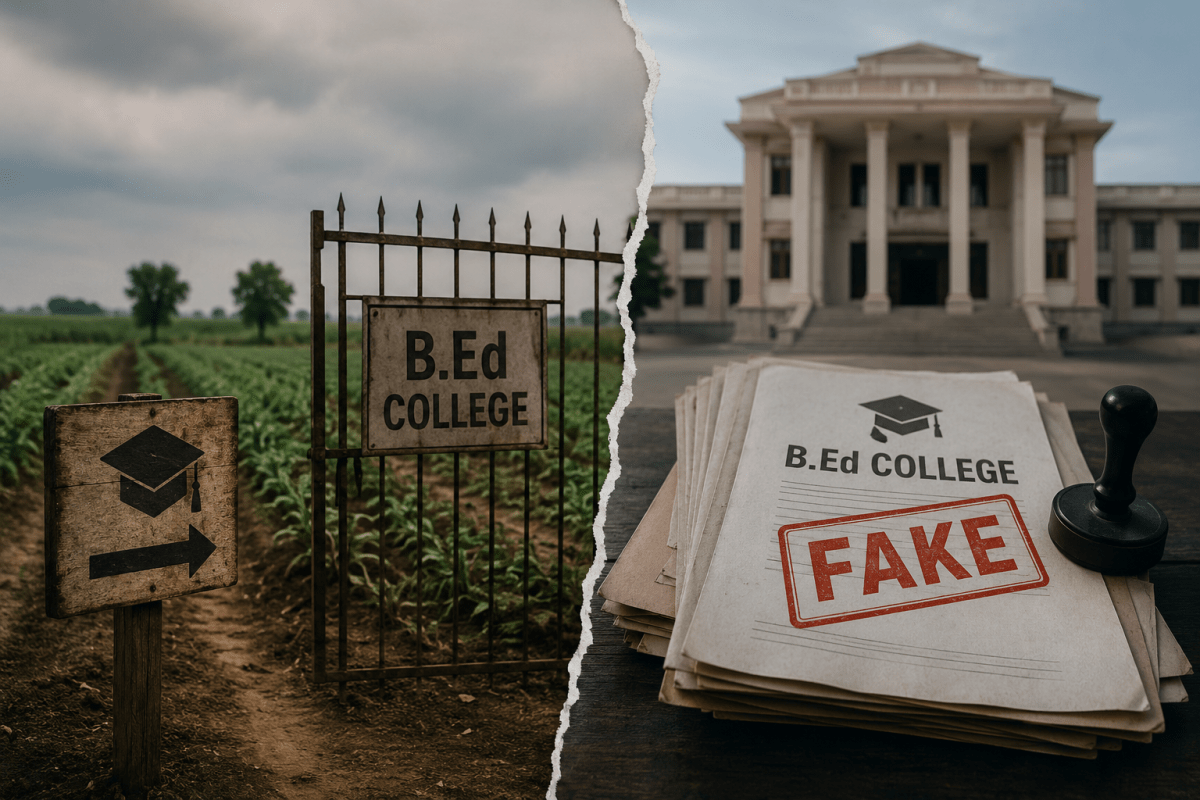
Not long after the nursing college scandal in Madhya Pradesh, a similar problem has come up in teacher-training colleges. An NDTV team visited several B. Ed colleges and found some of them do not really exist — the addresses on record were empty farmland, a single rented room, or space borrowed inside someone else's school. Yet these colleges kept admitting students, holding exams, and giving out degrees every year, on paper. Separately, internal documents from Barkatullah University (BU) show that dozens of private B.Ed colleges were allowed into this year's admission process based on just one signed affidavit — even though a fourth of the colleges checked had failed some part of a physical inspection. And this is not a one-off case. Courts, investigators, and the state's own anti-corruption wing have been flagging similar problems in MP's B.Ed colleges for at least two years.
A College That Only
Exists on Paper
The clearest example is in Mugaliya Kot village on Vidisha Road in Bhopal. Government records show a 'Shri Ram College' at a specific plot there, admitting 150 students every year — 100 for B.Ed and 50 for B.Sc-B.Ed — for close to ten years. When reporters went to check, there was no such college. The plot was just farmland, being actively used to grow crops. Nearby, there were a few unrelated buildings, one still under construction. But despite there being no real campus, the college's name kept showing admissions, exams, and degrees year after year.
This part of the story is backed up by a second, separate source. In March 2026, a local activist filed a complaint about the same college with the state Lokayukta (the anti-corruption ombudsman), and a Bhopal news outlet reported it independently in June. That report described the same missing building at the same address — though it said the college had been running like this for sixteen years, not ten. Two different sources agreeing on the core facts, even with a small gap on how long it's been going on, makes this part of the story solid.
It's Not Just One
College
Reporters found more of the same problem elsewhere in Bhopal. 'Saviour College' in Bawadiya Kalan is run out of a small school building that also houses a local society's office. Its principal admitted that gaps flagged by the university — like missing books and journals in the library — have only recently been fixed, and admitted that students don't attend regularly. In Saket Nagar, the address listed for 'Kamalnath B.P.Ed College' turned out to be just one room with a single teacher, who said the real college runs somewhere else. A member of the college society said they've been trying to move to a new site since 2015 and that students are bused elsewhere for practical classes. The obvious question: how did students keep getting admitted for years at an address nobody ever re-checked?
What the University
Found When It Actually Looked
Barkatullah University's own records list 129 B.Ed colleges under it, 127 of them private. When the university ordered physical checks of these private colleges, the results were bad: 25 colleges had major problems, 5 had serious issues, 2 could not even be found at their registered address, and 3 were secretly running from a different location than the one on file. That's roughly a quarter of all private colleges checked, found to have some kind of problem. Even so, these colleges were simply asked to sign a paper promising they met the rules, with the university saying it would cancel their affiliation later if problems showed up — in other words, students first, checking later.
A Minister's Note and
a Question Nobody Has Answered
Things got more political when an internal note tied to Higher Education Minister Inder Singh Parmar came to light. Parmar has held the higher education, technical education, and AYUSH portfolio in the Mohan Yadav government since December 2023. According to the documents, BU's registrar, Prof. Samar Bahadur Singh, cleared 82 B.Ed colleges on the online admission portal on the minister's instruction — before the university's Executive Council had formally approved them. Council members objected to this. The registrar defended it by saying inspection reports had already found these 82 colleges fit. But that raises a fair question: if the colleges were really fine, why skip the Council's formal approval, and why ask them to sign an affidavit at all?
This Has Been Building
for a While
This isn't the first time MP's B.Ed colleges have run into trouble. In 2024, the state's Special Task Force filed cases against six B.Ed/D.Ed college operators in Gwalior after finding their listed campuses were actually open fields. Officials at the State Council of Teacher Education and Jiwaji University, who had approved these same sites during inspections, are also under suspicion.
By February 2025, the state's Economic Offences Wing had expanded its inquiry to around 400 B.Ed colleges across the state, finding that most did not meet national teacher-training standards. It sent notices to the registrars of Barkatullah, Ujjain, and Indore universities asking for building, staff, and payment records. By April 2025, the EOW had specifically named 25 B.Ed colleges in Indore, including two run by the Kasliwal group, after complaints that colleges charged students up to roughly one lakh rupees while counting their own postgraduate students as regular faculty.
The courts have weighed in too. In February 2026, a Madhya Pradesh High Court bench threw out six petitions over B.Ed college affiliation, saying plainly that the sector had turned into a business rather than an education system. The court fined the colleges that filed the petitions and ordered full fee refunds for any students admitted without valid affiliation, and told the National Council for Teacher Education to tighten its own checks.
Barkatullah University has had its own separate mess going on at the same time. In mid-June 2026, the national teacher-training council halted BU's B.Ed courses over a shortage of faculty, and the university's Executive Council was deciding whether to restore affiliation for 36 B.Ed colleges whose renewals had been frozen. Around the same time, there was a leadership dispute at BU, with the registrar's office locked down amid a fight over who was in charge. None of this proves anything about the 125-versus-82 college numbers, but it shows BU's B.Ed department has been under pressure from several directions this year.
One more number worth knowing: in the most recent college counselling round, nearly 44% of B.Ed seats in the state — over 26,000 out of about 59,400 — went unfilled. That kind of vacancy gives private colleges a real financial reason to go easy on the rules, just to keep admissions coming in.
Verification Note
The main reporting here — on Shri Ram College, Saviour College, Kamalnath B.P.Ed College, the BU inspection numbers, and the minister's note — comes from one NDTV field investigation (reporter: Anurag Dwary), based on site visits, named quotes from college staff, and internal university papers. The Shri Ram College details are backed up by a second, independent report from Bhopal Samachar in June 2026, based on a Lokayukta complaint — though the two reports don't agree on how long the college had been running (about 10 years vs. 16 years).