
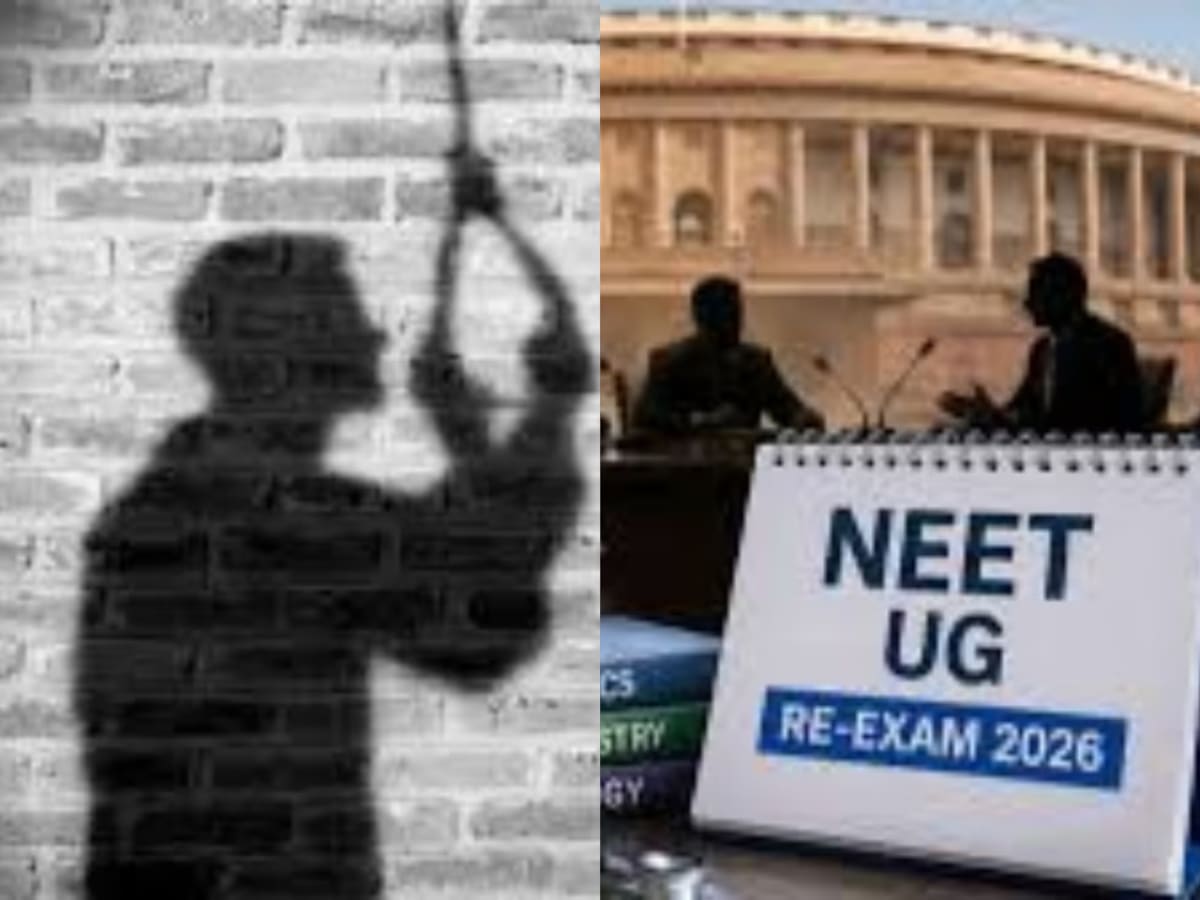
The Background
On May 3, 2026, over 2.27 million students sat for the NEET-UG — India's sole gateway to undergraduate medical and dental admissions. On May 12, the National Testing Agency cancelled the examination. The Rajasthan Police's Special Operations Group had found that 42 out of 45 questions in a mock paper circulated by a coaching institute in Latur, Maharashtra, appeared verbatim in the actual question paper. CBI investigations subsequently established that the leak network had spread across Rajasthan, Maharashtra, and other states, with NTA insiders implicated. On May 18, CBI arrested Shivaraj Motegaonkar, the owner of Renukai Chemistry Classes in Latur, who had received the chemistry questions as early as April 23, ten days before the examination.
The NTA announced a retest for June 21, giving over 22 lakh students roughly six weeks to prepare again. For a significant number of them, that announcement was not a second chance. It was the breaking point.
The Cases
1. Rajasthan-Jhunjhunu
A 22-year-old Dalit student had walked out of the May 3 examination feeling confident, telling his father that the paper had gone so well that "even God can't stop me from qualifying." After the cancellation, he died by suicide. No note was recovered.
2. Rajasthan-Sikar
22-year-old Umesh Mali, for whom the May 3 examination would have been his third attempt, died by suicide at his accommodation. He left behind a note that read: "Main is duniya se dur ja raha hun, sorry." Police registered a case and investigated the circumstances.
3. Madhya Pradesh- Mauganj
An 18-year-old student had spent years preparing for NEET at a coaching institute in Nagpur. Her parents had taken a loan of ₹3 lakh to support her education. After feeling confident about her May 3 performance, she died by suicide on May 20 — eight days after the cancellation was announced. Her note read: "Mom and Dad, you had faith that your daughter would become a doctor, but I no longer dare to take the NEET exam again."
4. Madhya Pradesh - Indore
A 19-year-old aspirant had become "unusually quiet" in the weeks following the cancellation, according to family members. She died by suicide. No note was recovered.
5. Maharashtra- Nagpur
20-year-old Akanksha Chaturvedi was found dead by suicide. Local police recovered a note tucked inside one of her medical preparation textbooks. It read: "I had high hopes of scoring good marks... but now there is no guarantee that I will perform just as well if I have to take the paper again."
6. Tamil Nadu - Coimbatore
19-year-old Anu Keerthana, a high-achieving student and daughter of a local trade union leader, died by suicide after experiencing severe anxiety about her ability to replicate her May 3 performance. Her note read: "I am sorry for being a burden. It's nobody's fault but my own incompetence."
7. Uttarakhand - Dehradun
A 23-year-old female aspirant died by suicide in her residence. Her note was addressed to her parents. Circle Officer Ankit Kandari told ANI the note expressed deep affection for her father but explicitly cited a crushing sense of "perceived incompetence" under renewed exam pressure.
8. Jharkhand - Ranchi
A 16-year-old female aspirant from Bihar died by suicide at her rented accommodation in the Chitragupta Nagar area. She was the youngest of the confirmed cases. No note was recovered.
9. Delhi - Three cases
The national capital recorded three separate aspirant deaths during this period. Among them was 18-year-old Renu Meena, originally from Alwar, Rajasthan, who had moved to Delhi to attend coaching classes and died by suicide in her accommodation. She had been preparing for NEET while living away from home.
10. Gujarat - Ahmedabad
Hours before he was to appear for the retest, a 17-year-old student died after falling from the sixth floor of a residential building in Ahmedabad's Tragad area in the early hours of June 18. His family said they were completely shocked. He had also applied for admission to a pharmacy course. His death brought the total to 13.
The Re-Test
On June 21, over 22.79 lakh candidates were required to appear across 5,440 centres in 551 Indian cities and 14 locations abroad — from 2 PM to 5:15 PM, in pen-and-paper format, in English and 12 Indian languages.
The NTA deployed an unprecedented security architecture to prevent a recurrence of the May 3 breach.
The Indian Air Force, paramilitary forces, police, and the Department of Posts were all mobilised for the secure transport of question papers. GPS-enabled vehicles with police escorts moved confidential material under sealed protocols. A nationwide mock drill on June 20 tested every layer of the system — jammers, cameras, biometric devices, frisking staff — the evening before the examination.
The Question
Thirteen people are dead. The youngest was 16, preparing for a future she never got to live. The oldest was 24, spending what may have been her last weeks studying for an exam she had already passed, taken from her by a criminal network she had no connection to.
None of them leaked the paper. None of them was corrupt. They were the system's victims, first from the breach, and then from the weight of having to prove themselves again in a country that gave them no choice.
The question that now sits before India's policymakers, medical establishment, and citizens is not merely whether the June 21 retest is secure. It is whether the architecture of a single, high-stakes, pen-and-paper national examination, held once a year, for 22 lakh students, with admission to every medical college in the country resting on a few hours, can continue to carry the psychological freight it is being asked to bear. The deaths suggest the answer may already be no.