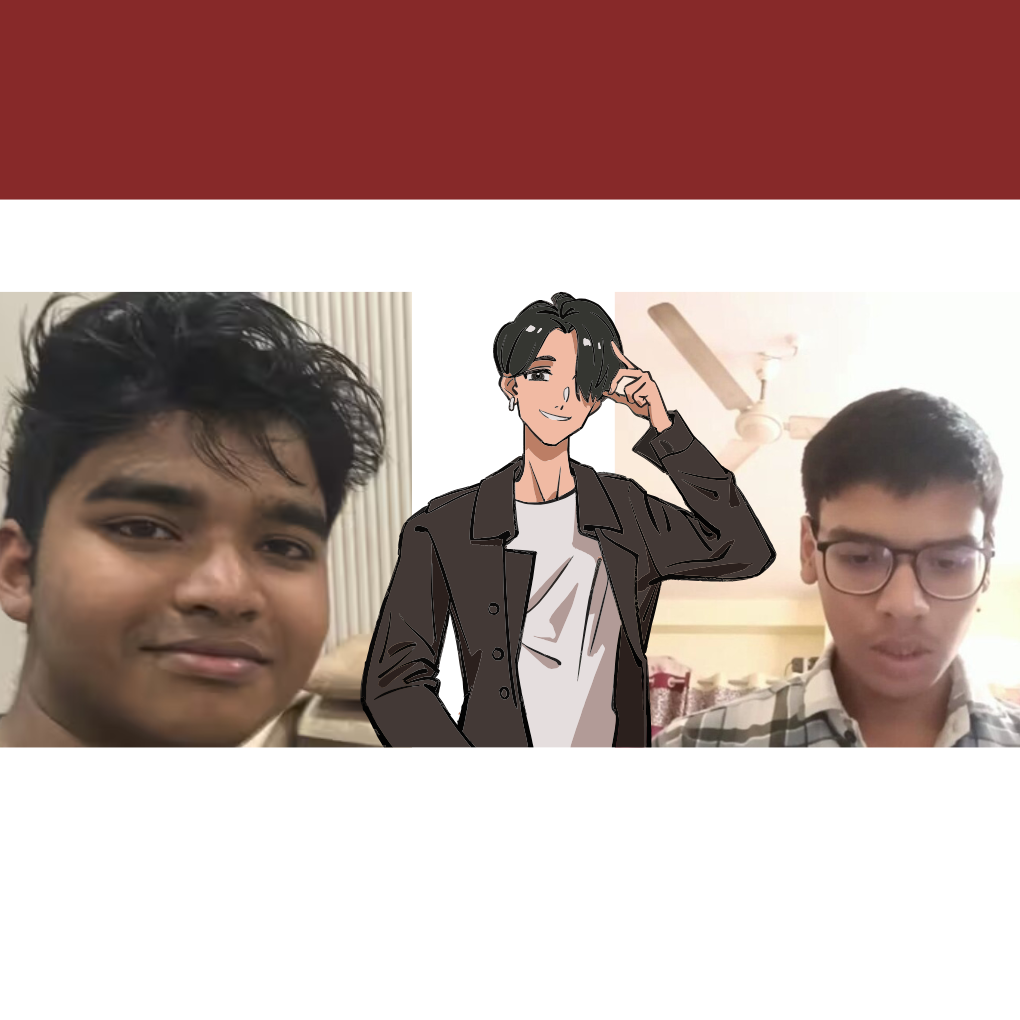
What began as a personal grievance over a misplaced answer sheet has snowballed into one of the most significant accountability crises in the history of Indian school education.
ACT ONE: THE WRONG ANSWER SHEET — Vedant Shrivastava, 17
It began when 17-year-old Vedant Shrivastava questioned his exam marks and applied for the official CBSE re-evaluation process. When the paperwork arrived, Shrivastava discovered the board had sent him an entirely different student's Physics answer sheet.
Rather than quietly accept the error or navigate an opaque grievance system, Vedant did what millions of young Indians do — he posted the evidence online. The response was swift, but not in the way one might expect from an accountable institution.
After he posted the evidence on X, he faced a coordinated smear campaign, with IT cells labelling the teenager a "Pakistani" in an attempt to discredit his claims. Shrivastava persisted, forcing the board to confront the systemic errors in its evaluation pipeline.
The alleged mix-up quickly went viral, raising concerns about the accuracy of the board's evaluation process and prompting CBSE to address the issue publicly. For the first time, the scale of the problem — students receiving wrong answer sheets, blurred scans, missing pages — was impossible to dismiss.
ACT TWO: THE SECURITY BREACH — Nisarga Adhikary, 19
While Vedant's story was still dominating headlines, a 19-year-old from a different corner of the country was quietly doing something far more technical.
Nisarga Adhikary successfully breached the CBSE website, discovering a critical vulnerability that left student data exposed. He initially reported the flaw directly to CBSE officials, but after receiving no response or corrective action, he took the findings public on X. His detailed breakdown demonstrated exactly how vulnerable the board's digital infrastructure was to malicious actors.
The ethical hacker's disclosure raised a chilling question: if a 19-year-old student could find and responsibly report a backdoor into one of India's largest digital examination systems, who else already had access — and what had they done with it?
Cybersecurity concerns mounted as ethical hackers claimed student data and answer sheets were exposed online. CBSE subsequently stated that detected flaws were fixed and that system security was being reinforced. But for critics, the admission itself confirmed what Nisarga had been saying all along.
ACT THREE: THE PROCUREMENT AUDIT — Sarthak Sidhant, 18
The most forensic investigation of the three came from 18-year-old Sarthak Sidhant, a Class 12 student from Jharkhand, who turned his attention not to the symptoms but to the root cause — the very system used to evaluate answer sheets.
Sarthak Sidhant alleged that changes were made in tender conditions that appeared to favour the vendor selected for the project. He repeatedly sought answers from the Board on why multiple tender revisions were required and why key provisions were altered.
What he found in the public tender documents was striking. CBSE's May 2025 tender had required answer sheets to be scanned with automatic robotic scanners, spines preserved, at a minimum of 300 DPI. The tender re-issued in August quietly removed all of it — "Scanners" became generic, and resolution dropped to 200 DPI.
One of the most significant changes Sidhant identified was the removal of a clause related to poor performance records — meaning a vendor with a history of underperformance could no longer be disqualified on those grounds.
Sidhant bypassed social media anonymity entirely, taking his factual evidence directly to mainstream media cameras to explain the procurement anomalies on the record. The blog he published was subsequently shared by opposition leader Rahul Gandhi and several other parliamentarians, who demanded an independent judicial inquiry.
CBSE and OSM contractor Coempt Edutech rejected the allegations. Union Education Minister Dharmendra Pradhan accepted responsibility for the issue and said steps would be taken to prevent similar problems in the future.
THE FALLOUT
The three investigations — conducted independently, by teenagers, without institutional backing — collectively triggered a national conversation that reached the highest levels of government.
The controversy came shortly after the cancellation of the NEET-UG examination over a paper leak, and the National Testing Agency faced fresh criticism after a technical issue delayed the CUET-UG 2026 examination at several centres — painting a broader picture of systemic fragility in India's examination infrastructure.
CBSE postponed the re-evaluation portal to June 1, 2026, aiming for a transparent and glitch-free process. The OSM rollout was intended to improve transparency and efficiency, but mounting errors and opaque responses have eroded confidence among students and parents.
Educationist Prof. Anita Rampal, speaking to The Federal, captured the significance of the moment. She said the actions of students such as Sidhant, Nisarga Adhikary, Vedant Shrivastava and others provided reassurance that young people remain willing to engage with public issues, and that what impressed her most was that several students were speaking not only for themselves but also for others who might have been adversely affected.
CBSE ACCEPTS THE IRREGULARITIES
For weeks, CBSE had maintained that its systems were functioning within established guidelines. Then, on May 31, 2026, the board's position cracked.
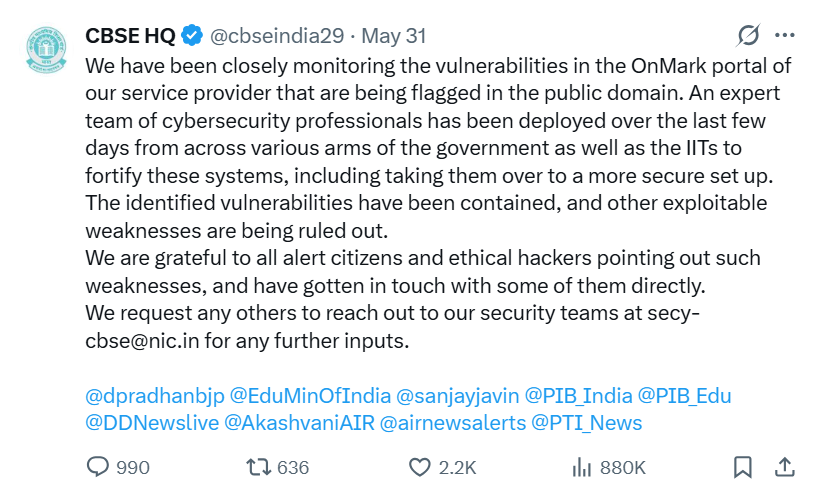
In an official statement posted on X, CBSE acknowledged the vulnerabilities in the OnMark portal and confirmed that a specialised team comprising cybersecurity experts from IIT Madras, IIT Kanpur, and several government agencies had been engaged to conduct a detailed security assessment and strengthen the system.
We have been closely monitoring the vulnerabilities in the OnMark portal of our service provider that are being flagged in the public domain. An expert team of cybersecurity professionals has been deployed over the last few days from across various arms of the government as well…