What Happened?
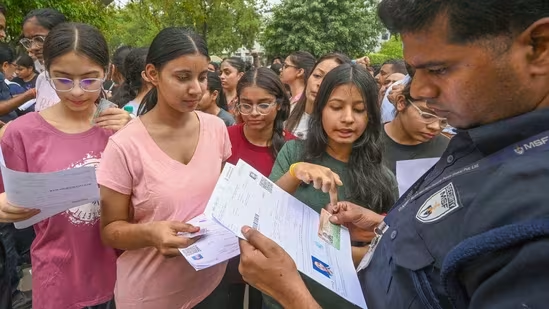
The disruption struck early on May 30, when candidates arrived at exam centres in Delhi, Noida, Bangalore, Varanasi, and several other cities, only to find that the testing systems had failed to function as expected. The technical fault, attributed to TCS iON — the technology partner responsible for managing the computer-based testing infrastructure — prevented candidates from beginning their exams on schedule.
The delay, stretching up to two hours at several centres, left students waiting in halls with no clear communication on when, or whether, the test would proceed.
NTA's Response: Extra Time and Re-Examination Offer
The National Testing Agency (NTA), which conducts CUET UG, moved quickly to manage the fallout. Candidates who remained at their centres after completing the verification process were granted compensatory extra time to complete the examination.
According to NTA, approximately 95% of the affected candidates stayed on and completed the test under these revised conditions.
However, a significant number of students — 3,765 candidates — chose to leave the examination centres after completing verification, unwilling or unable to wait further amid the uncertainty. For these students, NTA has announced a re-examination to ensure they are not penalised for the disruption caused by the technical failure.
NTA Expresses Regret, Orders Root-Cause Analysis
In an official statement, the NTA expressed regret over the distress and anxiety caused to students on what is one of the most important examination days of their academic lives.
The agency has also announced that a root-cause analysis is underway to identify precisely what went wrong with TCS iON's systems and to prevent a recurrence. NTA further assured students, parents, and institutions that the integrity and fairness of the examination have not been compromised in any manner.
Calls for Accountability
The incident has triggered sharp reactions from students, parents, and education commentators, with widespread calls for accountability — both from NTA and from TCS iON. Critics have pointed out that high-stakes national examinations cannot afford to depend on systems that fail under pressure, and questioned the robustness of quality checks carried out ahead of the exam day.
For many students, who spend months preparing for CUET UG as a gateway to admissions in central and other participating universities, the disruption has added unwanted stress to an already demanding process.
What's Next?
NTA has assured that the re-examination for the 3,765 impacted candidates will be scheduled at the earliest. The agency has also committed to sharing the findings of its root-cause analysis and the measures it plans to put in place to avoid similar failures in the future.
As of now, students who completed the examination on the day have been assured that their results will not be affected by the delay.