
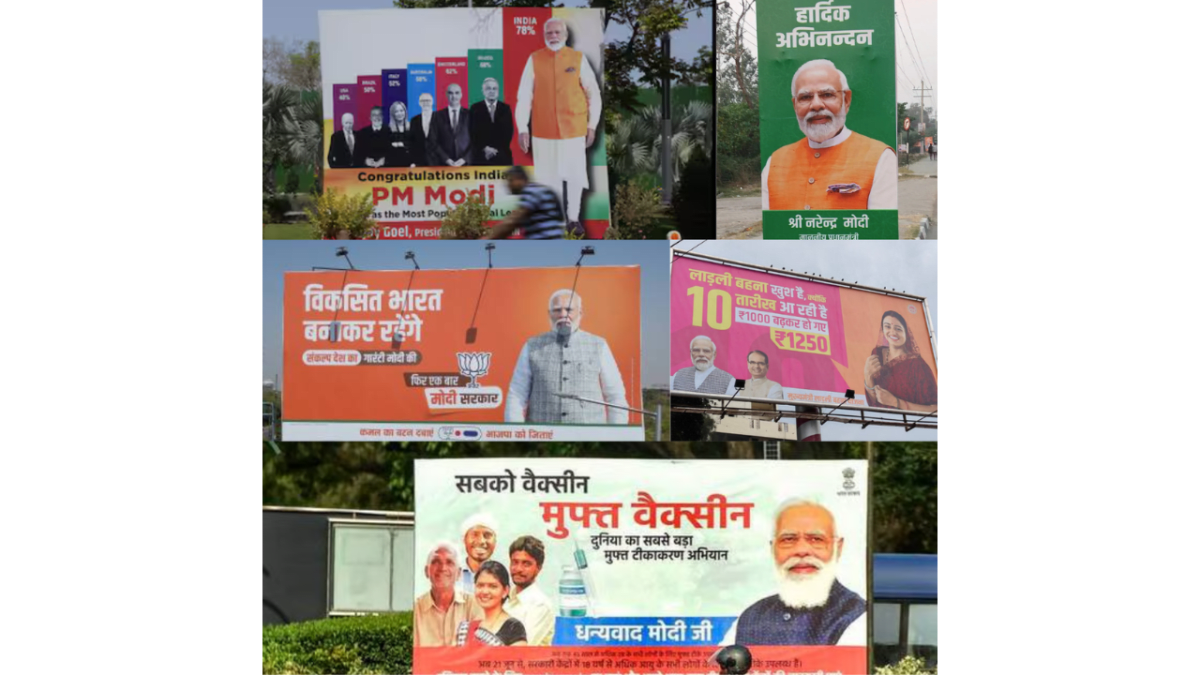
The RTI
On June 1, 2026, Gokhale filed an RTI application with the Ministry of Information and Broadcasting, seeking full disclosure of the amount spent by the Union government on advertisements featuring or promoting Prime Minister Narendra Modi across every media platform — including digital, social media, television, radio, print publications, and outdoor hoardings.
On June 16, the CBC responded with a year-wise breakdown of advertising expenditure routed through it, starting from the financial year 2020–21. The CBC is the government's nodal agency for managing and routing central government advertising across all media channels. The total figure disclosed: ₹2,586 crore over six financial years.
However, the CBC refused to disclose which media agencies, platforms, or outlets received the payments. The stated reason was "commercial confidence" — a standard exemption under RTI provisions that protects third-party commercial information. Gokhale has characterised this refusal as the more significant of the two disclosures, arguing that opacity regarding beneficiaries is precisely what enables political interference in media coverage.
The Data
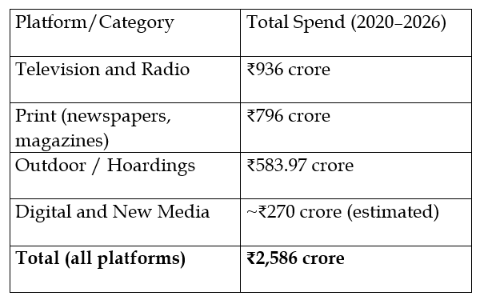
Among the most striking individual data points is the acceleration in print advertising in the final year of the period. Print spending of ₹338 crore in 2025–26 was nearly four times the ₹83.16 crore spent the previous year — a surge that coincides with the CBC's November 2025 revision of DAVP print advertisement rates upward by 26 per cent. On digital and social media, spending grew from approximately ₹14 crore in 2020–21 to ₹131.35 crore in 2025–26 — a nearly tenfold increase in five years.
Outdoor advertising shows the clearest electoral correlation. Spending on hoardings hit its lowest point — ₹32.76 crore — in 2022–23, the year before the general elections. The following year, 2023–24, it surged to ₹162.21 crore — a fivefold jump as the 2024 Lok Sabha campaign cycle intensified.
What is CBC? - What it is supposed to do
The Central Bureau of Communication is the Union government's nodal advertising and communication body, operating under the Ministry of Information and Broadcasting. It was restructured from the Directorate of Advertising and Visual Publicity (DAVP) in 2017. Its mandate is to plan, produce, and disseminate government communications — informing citizens of schemes, policies, and programmes — across print, broadcast, digital, and outdoor platforms.
Crucially, the CBC is funded by taxpayer money. Its advertising is not party advertising — it is government communication, paid for from the public exchequer. The political controversy around the CBC's spending arises specifically from the framing of its advertisements: whether they communicate government policies and public welfare schemes or primarily promote the personal image and political brand of the Prime Minister.
This distinction was examined in detail by an Al Jazeera investigation in May 2024, which found that in the 113 days before the 2024 general elections were formally announced, the CBC was the single largest spender on political advertisements on Google in India — outspending the BJP itself, with ₹38.7 crore against the BJP's ₹31.4 crore. Many of those advertisements were found to carry the BJP's election slogans, including "Modi ki Guarantee" verbatim.
What Rs 2586 crores does not include
Gokhale's central argument is that the ₹2,586 crore figure, significant as it is, represents an undercount. The CBC is one of several channels through which the government places advertising. Individual ministries route additional advertising directly to media outlets, outside the CBC framework. Public sector undertakings — ranging from oil companies to banks to defence firms — place their own advertising, much of which, critics argue, doubles as image promotion for the political leadership. And the BJP's own advertising budget, entirely separate from government spending, adds a further layer.
A 2024 report cited in the Al Jazeera investigation found that CBC's Google ad spending alone — in just four months in early 2024 — was 41 per cent more than the total amount the Congress party had spent on Google advertising over nearly six years. This indicates the structural asymmetry created when a government's communication agency, funded by taxpayer money, effectively acts as a campaign arm.
Note: The ₹2,586 crore figure is the official CBC disclosure in response to the RTI filed by Gokhale. It covers only advertising routed through the CBC. The government has not provided — and has not been compelled to provide — a consolidated figure covering all ministries, PSUs, and other government bodies. The CBC also refused to disclose agency names, citing commercial confidence. No official government rebuttal to the RTI figures had been issued at the time of publication.